Fault Lines: A Survival Story - Episode 4: The Long Haul

September 13th, 2026 – 06:11 a.m. – Disaster +5 Days
Dean walked the fence line alone. He had started doing it every morning. At first, it had been something practical.
Check the gates. Check the fence. Make sure the horses hadn't found some new and innovative way to escape. Look for damage from the aftershocks.

By the fifth morning, it had become something else. A routine. Maybe even an excuse to think without anyone asking him what they were going to do next.
The air was cool enough that Dean could see his breath when he stopped near the northern edge of the property. September mornings in the valley always carried a hint of what was coming.
Rain. Cold. Shorter days. Winter.
Normally, none of that bothered him. This morning it did.
Dean stopped beside one of the fence posts and looked back toward the house. The previous two days had been strangely quiet. No desperate trips into town. No fires. No rescues. No one knocking on the door asking for food or water.
Nate had stopped by once with an update on his family and to return some of the cash Dean had covered at the store. The visit lasted maybe ten minutes. Otherwise, the family had stayed on the property.
Dean and Jeff had spent most of that time going through everything Jeff and Christie already had. Dean had been pleasantly surprised. They weren't prepared in the way Dean thought about preparedness.
There were no carefully labeled buckets arranged by expiration date. No detailed inventory. No spreadsheet tracking fuel consumption. No laminated emergency plans.
Jeff considered most of that excessive.
But the supplies were there.
Food was the biggest surprise. Canned goods. Dry staples. Frozen meat. Home-preserved food. Bulk rice and flour.
Enough normal pantry food that, combined with Dean and Beth's supplies, they estimated they could feed everyone for close to three months if they were careful. Maybe longer.
Water was manageable. The well wasn't useful without power, but they had several ways to treat surface water, stored water, containers, filters, and enough property around them to start developing something more permanent.
Fuel was even better. Between the tractors, lawn equipment, generator, pickup, and other equipment scattered around the property, Jeff had accumulated a respectable amount of gasoline and diesel.
Dean had written down every gallon they could account for. Then reduced the number in his notebook slightly.
Jeff noticed.
"Why'd you take ten gallons off?" he asked.
"Because we're wrong." Dean replied.
"We counted it." Jeff said dropping the last diesel can into its storage location.
"We estimated it." Dean replied.
Jeff stared at him.
Dean shrugged.
"I'd rather find ten gallons later than plan around ten gallons that don't exist." Dean said.
Jeff shook his head.
"You're exhausting."
Christie had laughed from across the garage.
Dean had taken that as agreement.
The inventory had helped. It had also changed the problem. They were no longer asking whether they could survive the next few days.
They could.
The question had become how long they might need to.
Dean continued along the fence. The radio reports hadn't improved.
FEMA had still not established a meaningful presence in the valley. One of the regional staging facilities near Bothell had reportedly been heavily damaged during the initial earthquake. Warehouses had been lost. Vehicles had been trapped. Communications infrastructure had failed.
Some federal resources were moving into Washington. Just not enough. Not quickly. Not everywhere.
The military wasn't much better. The Washington National Guard had mobilized, but units were scattered across an enormous disaster zone. Active-duty Army units were supporting transportation, engineering, medical operations, and security wherever they could. Navy facilities had sustained damage. Airfields were operating with restrictions. Marine and Air Force units throughout the region were being reassigned wherever transportation allowed.
And then there were the personnel problems.
Dean had heard several versions of the same report. Some service members simply hadn't reported. Others had left their duty stations after losing contact with their families. Some were still listed as missing. Some had apparently decided that finding their spouses and children mattered more than whatever orders were waiting for them.
Dean understood.
That didn't make the consequences any smaller.
He reached the eastern corner of the property and stopped. The valley below remained mostly dark.
Five days.
Dean had spent the first day trying to get home. The second finding Beth and Walker. The third figuring out what they had. The fourth and fifth waiting for the situation to improve.
It hadn't.
His handheld radio crackled softly at his belt. Dean reached for it, expecting another local transmission.
Instead, the weather radio clipped to the outside of his pack suddenly emitted the emergency alert tone.
Dean froze.
The electronic alarm sounded unnaturally loud in the quiet morning.
He pulled the radio free.
A recorded voice began.
"...Emergency Alert System activation. Stand by for emergency information."
Static followed.
Then another voice came through. Not recorded. Human. Tired.
"...the United States Geological Survey is reporting a major seismic event affecting California. Preliminary measurements indicate a magnitude nine-point-five earthquake involving a major rupture of the San Andreas fault system. Severe shaking has been reported from the greater Los Angeles region through portions of the San Francisco Bay Area..."
Dean stared at the radio.
"No."
The broadcast continued.
"...multiple significant aftershocks are ongoing. Communications with numerous affected areas are intermittent or unavailable. Widespread structural damage has been reported. Residents throughout California, southern Oregon, Nevada, and surrounding areas are advised to remain alert for additional seismic activity..."
Dean slowly sat on the fence rail.
A nine-point-five. California. Five days after Cascadia.
The voice continued.
"...federal emergency management resources previously designated for Washington and Oregon are being reassessed following this morning's event. FEMA and other federal agencies have been directed to temporarily suspend some deployments while national emergency coordinators determine resource allocation between the Pacific Northwest and California disaster zones..."
Dean stopped breathing for a moment. Not literally. It just felt that way.
He turned the volume higher.
"...residents already within affected areas should continue following local emergency guidance. Communities capable of sheltering in place are strongly encouraged to conserve water, food, fuel, medications, and electrical power. Federal officials are asking for patience while the scope of the developing emergency is assessed..."
Dean laughed once.
There wasn't anything humorous about it.
Patience.
Five days without power. Roads destroyed. Fuel disappearing. Stores emptying. Hospitals overwhelmed.
And now California had been hit by something potentially even worse.
Dean looked south.
He couldn't see California. Couldn't see Oregon. Couldn't even see Seattle from where he stood.
But for the first time, the disaster felt bigger than the region.
Much bigger.
He switched radios.
The local GMRS repeater was already alive.
06:27 a.m.
"...anybody know if the water point at the high school is still running?"
Static.
"Negative. Heard they ran dry yesterday."
Another voice broke in.
"They didn't run dry. The tanker never showed."
"Same difference if you're standing there with an empty jug."
A different voice interrupted.
"Does anyone have insulin? Neighbor's got maybe two days left."
Someone replied immediately.
"Don't broadcast medications on an open repeater."
Then another.
"Anybody know if the pharmacy in North Bend is opening?"
"No."
"Safeway?"
"Mostly empty."
"Where are we supposed to get food?"
Dean listened.
The repeater had changed.
Two days earlier, people had mostly been sharing information. Road conditions. Shelters.
Missing family. Power status.
Now the questions were different.
Food. Water. Medicine. Fuel. Help.
The pauses between transmissions were shorter. Voices overlapped. People interrupted one another. Arguments started and disappeared beneath static.
Someone claimed FEMA had abandoned Washington. Someone else said military convoys were already moving north. Another person said the government was lying about casualty numbers. Someone claimed California was "gone." Someone else told him to stop spreading nonsense.
Dean switched the volume down.
None of them knew.
That was the problem.
Nobody knew enough.
And uncertainty was beginning to turn into fear.
Dean looked toward the house.
Time to tell everyone.
06:46 a.m.
Jeff was already awake.
Dean found him in the kitchen pouring hot water through a coffee filter. Beth sat at the table with Walker eating cereal. Christie was cutting an apple into slices.
Dean walked in carrying both radios.
Beth looked at his face.
"What happened?" she asked.
Dean put the NOAA radio on the table.
"California." Dean replied sitting down.
Jeff stopped pouring and asked, "What about it?"
"Major earthquake this morning." Dean replied.
"How major?" Jeff asked Mid-Pour.
"Preliminary nine-five." Dean said looking over at Beth.
Silence.
Jeff slowly set the kettle down.
Beth stared at Dean.
"Nine point five?" she repeated.
"That's what they're reporting." Dean nodded.
"Where?"
"San Andreas system. They're saying damage from Los Angeles through San Francisco."
Christie stopped cutting the apple.
"Oh my God." she said quietly.
Walker looked between the adults.
"Another earthquake?"
Beth immediately reached for him.
"Far away from us, buddy."
Dean didn't correct her.
Far away was relative.
"What about FEMA?" Jeff asked.
Dean pulled out a chair.
"Some deployments are being suspended while they figure out where resources are going."
Jeff stared at him.
"So they're taking our people and sending them south."
"I don't know." Dean said shaking his head.
"That's what you just said."
"No. I said they're reassessing."
Jeff gave him a look.
Dean understood the frustration.
But frustration couldn't be allowed to become information.
"Until we know otherwise, we assume what's already here is what we've got."
Beth leaned back.
"For how long?" she asked.
Dean didn't answer immediately.
That was answer enough.
Christie sat down across from him.
"What do we need to do?"
Dean looked around the table.
Five days ago they had been waiting for power. Three days ago they had been waiting for FEMA. Yesterday they had still been talking about what would happen when roads reopened.
This morning felt different.
"We stop planning for a week."
Jeff nodded slowly.
Dean continued.
"We start planning for months."
07:18 a.m.
A vehicle came up the driveway.
Dean heard it before he saw it.
He stepped outside.
Nate's truck rolled slowly toward the house.
Dean immediately noticed something unusual.
Nate had driven.
He hadn't taken Molly.
That meant the roads had improved enough to travel.
Or Nate had decided he didn't care.
The truck stopped near the barn.
Nate climbed out.
His expression told Dean it was probably the second one.
"You heard?" Nate asked reaching his hand out.
"California?" Dean replied while shaking Nates hand.

Nate nodded.
"Just got back from town."
Dean walked toward him.
"How bad?" Dean asked.
Nate looked back toward his truck.
"Bad enough I'm not going again."
Jeff came outside behind Dean.
"What happened?" Jeff asked shaking Nates hand.
"Most of the stores are done." Nate replied.
"Empty?"
"Some. Others got broken into."
Dean folded his arms.
"The grocery store?" he asked.
"Windows smashed. People fighting over what was left."
"When?"
"This morning."
Nate rubbed the back of his neck.
"Hardware store got hit overnight. Pharmacy too. Sheriff's deputies were there, but there's not enough of them."
"Any shooting?" Jeff asked.
"I heard some. Didn't see it."
Dean glanced toward the road.
"What about fuel?" Dean asked,
Nate laughed.
"There isn't any."
"None?"
"Gas station's dry. One place supposedly had diesel yesterday, but that's gone too."
Jeff muttered something under his breath.
Nate continued.
"People are blaming FEMA. State. President. Governor. Everybody."
"That'll help," Dean said.
Nate almost smiled.
"Apparently we're solving this through yelling."
Humanity's most renewable resource.
Dean looked back at him.
"What did you get?" he asked.
"Nothing."
Nate paused.
"Didn't seem worth getting punched over canned beans."
Dean nodded.
"Probably wasn't."
Nate looked toward the house.
"You guys okay?"
"For now."
"Same."
Another pause.
The same phrase everyone had started using.
For now.
Nate climbed back into his truck.
"I'm keeping Selena and the kids home."
"Good."
"You need something, radio me."
"Same."
Nate nodded and drove away.
Dean watched until the truck disappeared.
Then he turned toward Jeff.
"We start today." He said.
"Start what?"
Dean looked over the property.
"Everything we've been meaning to do."
08:02 a.m.
The kitchen table disappeared beneath paper. Property maps. Notebook pages. Old sketches. A tape measure. Two pencils. One cup of coffee Dean had forgotten about twenty minutes earlier. Dean drew three headings.
WATER
FOOD
STORAGE
Jeff leaned over the table.
"Rainwater first." He said pointing at the notes in front of Dean.
"Agreed."
The house, barn, shop, and other structures gave them plenty of roof area. They already had
gutters. They had barrels. Several large containers could be repurposed.
They would need to direct runoff into storage and develop a system for treating anything intended for drinking.
Dean circled it.
"That's today."
Jeff tapped another section.
"Root cellar."
They had talked about building one for years. Technically, they had already started. A partially excavated section on the shaded side of the property had been intended for cold storage, but like countless other projects, it had remained permanently trapped in the category of we'll finish it eventually.
Eventually had apparently arrived.
"We can get the basic structure usable," Jeff said.
"Doesn't need to be pretty."
"It was never going to be pretty."
"Good. We're ahead."
Dean wrote:
ROOT CELLAR – PRIORITY
Then:
GREENHOUSE
The existing greenhouse was useful. It wasn't enough. They had materials. Lumber. Plastic panels. Fencing. PVC. Old irrigation supplies. Some of it would work. Some of it wouldn't.
They could expand growing space now while the weather was still cooperative. Jeff stared at the list.
"You're planning for winter." he stated.
"I'm planning for spring." Dean replied.
Jeff looked at him.
That landed. Dean continued writing. Seeds. Soil amendments. Hand tools. Water storage. Animal feed. Preservation supplies. Fuel. Firewood. Propane. Medical. Communications. Beth came into the room.
"Anything I can do?" she asked.
Dean looked up.
"Start figuring out what food we can preserve without refrigeration."
"I'm already doing that."
"Of course you are."
She looked at the page.
"Greenhouse?"
"We expand it."
"When?"
"As soon as we can."
Beth stared at the plans.
"You're really thinking this lasts that long."
Dean didn't answer.
The radio on the table crackled.
A familiar voice came through.
Weak. Broken.
"Dean... Dean, are you there?"
Beth turned immediately.
"That's Grandma."
Dean grabbed the radio.
"Go ahead."
Static.
Then Beth's grandmother again.
"There's someone at Margaret's house."
Dean frowned.
"What do you mean someone?"
"I saw two people come out of the back. Her door's broken."
Beth stepped closer.
"Is Margaret there?"
"No. She's with her daughter."
Dean keyed the radio.
"Stay inside. Lock the doors."
A pause.
"There's someone by my shop now."
Dean was already moving.
09:11 a.m.
The pickup started on the second turn. Dean hated how loud the engine sounded. Five days earlier it was just a truck. Now every second it ran represented fuel he might not be able to replace. He threw his bag behind the seat, checked the radio, and pulled onto the road. Beth's grandmother lived roughly a mile away. Normally, Dean wouldn't have thought twice about the distance. Today he considered whether driving was worth it. It was. Too much could happen in the time it took to walk. The road itself was passable. One section had cracked badly enough that Dean slowed almost to a crawl. A tree still leaned over one shoulder. Otherwise, the drive took only a few minutes. Her driveway came into view.
The house looked intact. The detached shop sat farther back. One of the doors was open.
Dean stopped the pickup near the house. Beth's grandmother opened the front door almost immediately.
"He's in the shop."
"Stay here."
"Dean..."
"Please."
She nodded.
Dean walked toward the shop. His heart rate had already climbed. He could hear movement inside. Metal scraping. Something falling. Dean stopped several yards from the doorway.
"Hey!"
The noise stopped. A man stepped into view. Maybe thirties. Maybe forties. Dirty clothes. Backpack. He was carrying a red gasoline can in one hand and a canvas tool bag in the other. For several seconds, neither spoke. Dean recognized him vaguely. Local. He couldn't place the name.

"Put it down," Dean said.
The man looked at the gas can.
Then back at Dean.
"She has plenty."
"Doesn't matter."
"Gas stations are empty."
"I know."
The man tightened his grip on the bag.
"My family's got nothing."
Dean believed him.
That made the situation worse, not better.
"Put the stuff down."
The man took a step forward.
"I'm not hurting anybody."
"You're stealing from an old woman."
"I'm taking gas."
"And tools."
The man glanced toward the house.
Dean moved slightly, keeping himself between him and the driveway.
"Don't."
The man looked back at him.
"You gonna stop me?"
Dean felt the conversation shift.
There it was.
The moment when neither person really wanted what came next, but pride was trying desperately to arrange it anyway.
Dean kept his voice level.
"I don't want this to become something else."
"Then move."
"No."
The man stepped closer.
Dean didn't.
They were maybe ten feet apart now.
The gas can hung from the man's hand. The tool bag was heavy enough that his shoulder leaned slightly. Dean could smell gasoline.
For one stupid second, Dean imagined how absurd it would be if five days of earthquakes, fires, and walking across half the region ended with two grown men fighting over a five-gallon fuel can.
The man apparently reached the same conclusion. Or maybe he saw something in Dean's expression he didn't like. Either way, his shoulders dropped.
"You people have everything."
Dean said nothing.
The man tossed the tool bag onto the gravel. Then the gas can. It hit hard enough that Dean winced.
"Hope you're proud of yourself."
Dean watched him.
"I'm not."
The man stared at him for another second. Then turned and walked toward the road. Dean let him. He didn't chase him. Didn't threaten him. Didn't try to find out where he lived.
He simply watched until the man disappeared beyond the trees. Only then did Dean realize how tightly his hands were clenched. He opened them. Beth's grandmother had come onto the porch.
"I told you to stay inside."
"I heard yelling."
Dean looked at the shop.
Then toward the road.
"Pack a bag."
She frowned.
"What?"
"Clothes. Medication. Anything you can't replace."
"Dean, I'm not leaving my house."
"You're not staying here alone."
"I've lived here thirty years."
"I know."
"This is my home."
"I know."
"Then stop telling me to leave it."
Dean looked at the broken shop door. Then toward Margaret's house. Its rear door was visibly damaged. Five days ago that neighborhood had been quiet.
Today someone was stealing fuel in broad daylight.
“Mary"
She looked at him.
"We'll come back."
She didn't answer.
"You're not abandoning it. We're moving you somewhere you aren't alone."
That finally seemed to land.
She looked toward her house.
Then sighed.
"How much can I bring?"
Dean looked toward the old truck parked beside the shop. His truck now.
Her 1978 Chevy before.
He almost smiled.
"As much as we can fit."
10:04 a.m.
The old Chevy started. They loaded the bed first. Fuel cans. Tools. Shelf-stable food. Blankets. Medical supplies. Batteries. A chainsaw. Hand tools. Several cases of bottled water. Propane. Anything useful that could disappear before they returned.
Beth's grandmother packed two bags of clothing and a small box of photographs. Dean noticed the photographs.
He didn't comment. Practicality had limits. When the truck bed was full, she climbed behind the wheel. Dean looked at her.
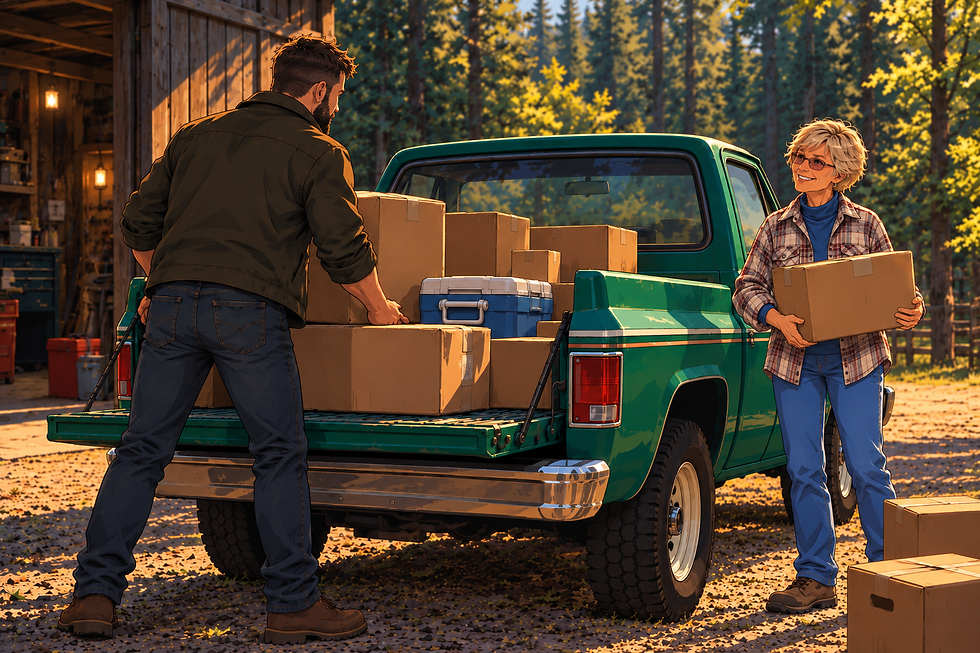
"You good driving this?" he asked
She gave him a look.
"I was driving this truck before you were born."
"Fair."
The drive took less than five minutes to reach the property. Beth was standing outside when they arrived. She saw her grandmother driving the Chevy and immediately understood that something had changed. Dean parked. Beth walked over.
"What happened?" she asked
"Someone broke into Margaret's house. Then I caught someone taking fuel and tools from your Grandma's shop."
Beth looked towards her grandmother.
"Are you okay?" she asked.
"I'm annoyed." Mary replied.
Dean nodded.
"She's okay."
Beth looked back at him.
"What happened with the guy?"
"He left."
"Just left?"
"Eventually."
Beth stared at him for a moment.
Dean shook his head.
"Nothing happened."
"But it almost did."
Dean didn't answer.
Again, that was enough.
Jeff came from behind the barn.
"What do you need?"
Dean looked at everyone.
"No one goes anywhere alone anymore."
Jeff stopped.
Dean continued.
"Property checks. Town. Your Grandma's. Anything outside the gate. Two people minimum."
Christie stepped outside.
"Isn't that a little extreme?"
Dean looked toward the road.
"Yesterday I would've said yes."
No one argued.
10:37 a.m.
Dean and Beth returned to her grandmother's house together. This time the pickup bed was empty. Dean kept glancing toward the neighboring homes as they drove.
Most looked deserted. Some probably were. People had gone to shelters. Family. Friends. Anywhere with electricity. That left empty houses.
Empty houses contained food. Fuel. Tools. Medicine. Everything desperate people were starting to need. At the house, Beth went room by room with her grandmother's list. Medication. Warm clothing. Boots. Blankets. Flashlights. Batteries. Food. Pet supplies. Documents. Dean concentrated on the shop. Fuel. Extension cords. Hand tools. Hardware. Oil. Rope. Tarps. Buckets.
Anything that could support the work they were planning back at the property.
He deliberately left things behind. Furniture. Television. Decorations. Most clothing.
Items that had value only if normal life returned.
Beth emerged carrying another box.
"What about the freezer?"
Dean opened it.
Meat.
A lot of it.
Still cold.
Some beginning to soften.
"Take it."
"All of it?"
"Everything we can preserve."
They loaded coolers.
The pickup sagged slightly by the time they finished.
Beth closed the tailgate.
"This feels like we're evacuating her."
"We are."
"She doesn't think we are."
"I know."
"Are we coming back?"
Dean looked at the house.
"Yeah."
"When?"
He didn't answer.
Beth didn't ask again.
12:18 p.m.
Jeff had made progress while they were gone. The unfinished root cellar looked less like an abandoned project and more like something that might actually become useful. He had cleared the remaining debris, reinforced part of the unfinished structure, and started organizing materials nearby. Dean set down a box.
"How far can we get today?"
"Enough to use it."
"Safe?"
Jeff looked offended.
"Yes."
"Had to ask."
"You don't trust anything."
"I trust verification."
"You should put that on a shirt."
Dean looked at the expanding pile of supplies.
"Maybe later."
They worked.
Jeff focused on the cellar. Dean started laying out the rainwater project.
Existing gutters would do most of the work. Several unused containers could provide immediate storage. It wasn't perfect. It didn't need to be. They needed capacity.
Dean made notes about which water would require treatment before drinking and which could be reserved for washing, animals, or irrigation. Beth and Christie worked through the food. Refrigerator. Freezer. Grandma's freezer.
Anything approaching the end of safe storage moved into the priority pile. By early afternoon the kitchen looked like someone had attempted to open a small grocery store during an electrical fire. Walker wandered through.
"Why is all the food out?"
Beth pointed toward the living room.
"Not now."
He considered arguing.
Then apparently decided four adults surrounded by food containers represented unfavorable odds.
He retreated.
02:46 p.m.
The GMRS repeater rarely stopped.
Dean kept a handheld clipped to his belt while he worked.
"...water distribution canceled..."
Static.
"...heard they arrested people at the gas station..."
Another voice.
"Negative. Sheriff's office left because the crowd got too big."
Another.
"My sister's in Bellevue. Says there are fires again."
"From what?"
"Don't know."
Another transmission stepped over the first.
"...anyone got family in Seattle? We're hearing downtown is bad."
"Define bad."
"Stores getting hit. Police stretched thin."
"That's been happening for two days."
"It's worse."
Dean kept working. The tone mattered more than the details now. Everyone sounded angry. Or afraid. Often both. The California earthquake dominated the wider broadcasts.
Information came in fragments. Freeways destroyed. Fires throughout Los Angeles. Severe damage across several cities. Ports closed. Airports damaged. Hospitals overwhelmed. Millions without power. Federal emergency declarations expanding. Military resources shifting south.
Then another report contradicted half of it. Dean had stopped writing down casualty estimates. They changed every hour. What mattered was what California represented.
Another enormous demand on the same national system Washington had been waiting for. Resources didn't multiply because two places needed them.
04:07 p.m.
Jeff climbed out of the root cellar and wiped dirt from his hands.
"Usable."
Dean looked inside. It wasn't finished. Not even close. But it was cool. Protected. Sheltered from direct sunlight. Shelving could be added later. For now, it gave them somewhere to move supplies that benefited from stable temperatures.

"Good enough."
Jeff nodded.
"Never thought I'd hear you say that."
"Don't get used to it."
They began moving supplies. Potatoes. Onions. Canned goods. Preserved food. Items from Grandma's house. Dean updated the inventory as they went. The numbers were increasing. That should have made him feel better. Instead, he kept thinking about the man in the shop.
You people have everything.
They didn't. But to someone with nothing, it probably looked that way. Dean looked toward the driveway. They needed to be careful about what people knew. That thought made him uncomfortable. Five days ago neighbors had shared water. Today Dean was thinking about hiding supplies.
05:33 p.m.
The sun was dropping lower when the first distant gunfire rolled through the valley. Dean stopped carrying a box. Jeff stopped too. Three shots. Pause. Then several more. Fast. Irregular. Far enough away that direction was difficult to judge.
Jeff looked at Dean.
"Hunting?"
Dean listened.
Another burst.
"No."
"Target shooting?"
Dean shook his head.
Nobody was burning ammunition like that five days into a disaster for entertainment. Another shot echoed farther away. Then nothing. Jeff picked the box back up. Neither man commented. There wasn't anything useful to say. Ten minutes later, the radio came alive.
"Anyone else hearing shooting?"
Several voices answered at once.
Dean turned the volume down.
06:17 p.m.
Someone on the repeater had managed to get television news. Then several people had.
Generators. Old televisions. Antennas. Satellite systems that still worked intermittently.
Reports started flowing back through the radio. The strange part was how different the television coverage sounded from what people were seeing locally.
One person complained that a national network was describing Washington as "stabilizing." Another said the broadcast had spent nearly the entire hour on California. Someone else said Seattle unrest was being described as isolated looting.
That triggered an argument.
"Isolated? Pike is a mess."
"You there?"
"My brother is."
"Then your brother knows more than CNN or FOX?"
"Right now? Maybe."
Someone else broke in.
"They're not showing any of it."
Another voice answered.
"Stop with the conspiracy crap. California just got hit by a nine-five."
"Then why aren't they showing Seattle?"
"Because Los Angeles is on fire!"
Three people transmitted simultaneously.
Static swallowed all of them.
Dean shut the radio off.
Beth looked up from the kitchen.
"That bad?"
"Worse." He replied
"The news?"
"The people listening to it."
Beth wiped her hands.
"What are they saying?" she asked.
"That national coverage isn't matching what people here are reporting."
"Meaning?"
Dean hesitated.
"Could mean reporters can't get here."
"Could mean they're focused on California." She added.
"Yes."
"What do you think?"
Dean looked toward the silent radio.
"I think we don't know enough."
That was true.
Mostly.
But something had been bothering him since the first day.
Cell service had failed almost completely. Internet connectivity was scattered. Most commercial radio stations had disappeared or were operating irregularly. Local television was largely inaccessible without power. NOAA and government emergency channels remained remarkably consistent.
Maybe that was exactly what a disaster looked like.
Infrastructure failed unevenly. Government systems had redundancy. Emergency networks received priority. That was the rational explanation. Dean preferred it. Still, the thought remained.
What if information wasn't merely failing to get out? What if someone was controlling what got through? He hated the idea. Mostly because he couldn't prove it wrong.
"I need a television," Dean said.
Beth stared at him.
"You told Walker television was a waste of generator power."
"This is different."
"He's going to love that."
Dean ignored her.
"There's an old TV in the shop."
"Does it work?"
"Probably."
"That's not encouraging."
"I'll need an antenna."
Beth smiled faintly.
"Good. Another project."
Dean looked toward the shop.
Another project suddenly seemed preferable to another rumor.
07:02 p.m.
Dinner used the last of several things that still resembled normal grocery shopping. Fresh lettuce. Tomatoes. Half a cucumber. Cheese. Chicken that had spent too long in a warming refrigerator. The kind of meal none of them would have remembered a week earlier.
Tonight everyone noticed.
Christie put the bowl of salad on the table.
"That's the last of the lettuce."
Walker looked at it suspiciously.
Dean almost laughed.
Civilization might collapse before his son voluntarily mourned lettuce.
They ate.
Mary sat beside Christie.
Jeff arrived late, dirt still embedded beneath his fingernails.
"Cellar's ready enough."
Dean looked up.
"For tonight?"
"For storage."
"Good."
Jeff started serving himself.
"What about the meat?"
Dean glanced toward the kitchen.
Between their freezers and Mary's, they had a significant amount beginning to thaw.
"We start tomorrow."
"Cook it?"
"Some."
Dean counted mentally.
"We'll run the generator longer. Dehydrate what makes sense. Freeze-dry what we can."
Jeff frowned.
"That's going to eat fuel."
"I know."
"How much?"
"Enough that I'm going to hate it."
Jeff leaned back.
"So why do it?"
Dean looked around the table.
"Because right now we have meat and fuel."
He paused.
"A week from now we might have spoiled meat and still have less fuel."
Jeff nodded slowly.
Dean continued.
"We spend some fuel now to turn food that might spoil into food we can keep."
"Insurance."
"Basically."
Beth looked at him.
"Expensive insurance."
"Everything's expensive now."
No one argued with that. Outside, another distant series of gunshots echoed through the valley. This time no one stopped eating.
Dean noticed that.
He didn't like it.
08:14 p.m.
After dinner, Dean went to the shop. The television was where he remembered.
An older flat screen covered in dust behind a stack of boxes. Dean pulled it free. Walker appeared behind him.
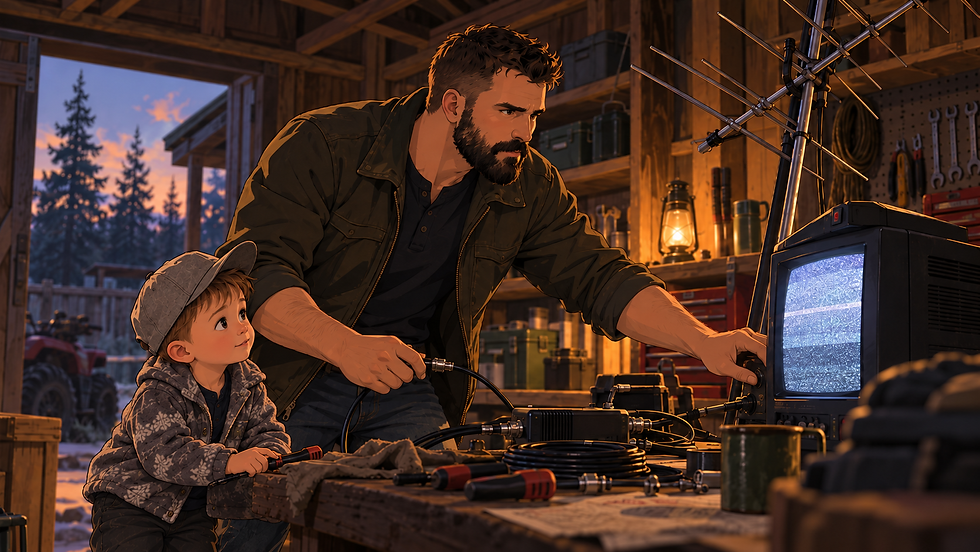
"Dad?"
Dean closed his eyes briefly.
Here it came.
"Yeah?"
"Why do you get TV?"
"It's for news."
"You said TV wastes power."
"It does."
"So..."
Dean turned.
Walker stood with his arms crossed.
Beth had clearly been teaching him advanced interrogation techniques.
"This is emergency television."
Walker stared at him.
"That's not a thing."
"It is now."
Walker considered this.
"Can emergency television play cartoons?"
"No."
He walked away.
"Then it's dumb."
Dean watched him leave.
"Hard to argue with that."
Jeff stepped into the shop.
"What are you doing?"
"Seeing if this works."
"And then?"
"Antenna."
"You have one?"
"No."
Jeff smiled.
"So you have a television."
"Correct."
"That doesn't receive television."
"Currently."
Jeff looked toward the workbench.
"What do you need?"
Dean glanced at the collection of wire, old coax, connectors, and assorted pieces they had accumulated over the years.
"Time."
Jeff nodded.
"We have plenty of that."
Dean wasn't sure they did.
08:48 p.m.
They moved the last of the supplies into the root cellar by flashlight.
Dean checked the gate afterward.
Then the barn.
Then the fuel.
Then the trucks.
Again.
Beth found him beside the old Chevy.
"You've started checking everything twice."
"I know."
"Planning on sleeping tonight?"
"Eventually."
She stood next to him. The valley beyond the property was almost completely dark. A glow hung faintly toward the west. Dean couldn't tell whether it was generator-powered lights, fire, or something else. The GMRS radio crackled from his belt.
"...reports of another fire near..."
Static.
"...stay away from downtown..."
Another voice.
"...anyone know if Guard is coming east?"
Static again.
Then:
"My neighbor hasn't eaten since yesterday."
Another voice answered.
"I've got kids."
Another:
"We all have families."
Dean lowered the volume.
Beth leaned against him.
"Five days."
Dean nodded.
"It feels longer."
"Yeah."
"What happens if FEMA doesn't come?"
Dean looked toward the house. Jeff. Christie. Grandma. Walker. The food. Fuel. Water. Tools. Animals. Land. Everything they had spent the day gathering into one place.
"We keep going."
"For three months?"
"If we have to."
"And after that?"
Dean looked toward the unfinished greenhouse. Then toward the dark shape of the root cellar.
"That's what we start figuring out tomorrow."
09:16 p.m.
The house settled into silence. Walker had fallen asleep on the couch before anyone convinced him to go upstairs. Grandma had taken the guest room. Jeff and Christie were finishing dishes. Beth was writing down the next day's food plan. Dean sat at the kitchen table with his notebook. He turned past the earlier pages.
DAY THREE
Inventory. Rations. Fuel. Medical.
The problems had seemed serious then.
They looked almost simple now.
He opened a clean page.
At the top he wrote:
LONG TERM
Underneath it:
Water capture.
Root cellar.
Greenhouse expansion.
Food preservation.
Fuel conservation.
Firewood.
Medical.
Security.
Dean stopped. He stared at the last word. Five days ago it had meant locks. Gates. Flashlights. Maybe keeping a rifle nearby. Today someone had broken into a neighbor's home. Someone had walked into Grandma's shop and started carrying away fuel. Gunfire had echoed across the valley before dinner. Dean added another line.
Nobody alone.
He closed the notebook.
Outside, another faint crack echoed somewhere in the distance.
Then another.
Dean waited.
Nothing followed.
The refrigerator hummed briefly while the generator completed its final run of the night.
Tomorrow they would burn more fuel than he wanted preserving meat that would otherwise spoil. They would expand water storage. Start planning additional growing space. Finish what they could on the cellar. Get the television working. Try to understand what was actually happening outside the valley.
Five days ago Dean had believed the earthquake was the disaster. Now California was broken too. Federal resources were being divided. Stores were empty. People were scared. And the first cracks in the thin layer of normal behavior were starting to show.
Dean looked toward the dark window.
He couldn't shake the feeling that the earthquakes weren't the story anymore.
They were only the beginning.


Comments